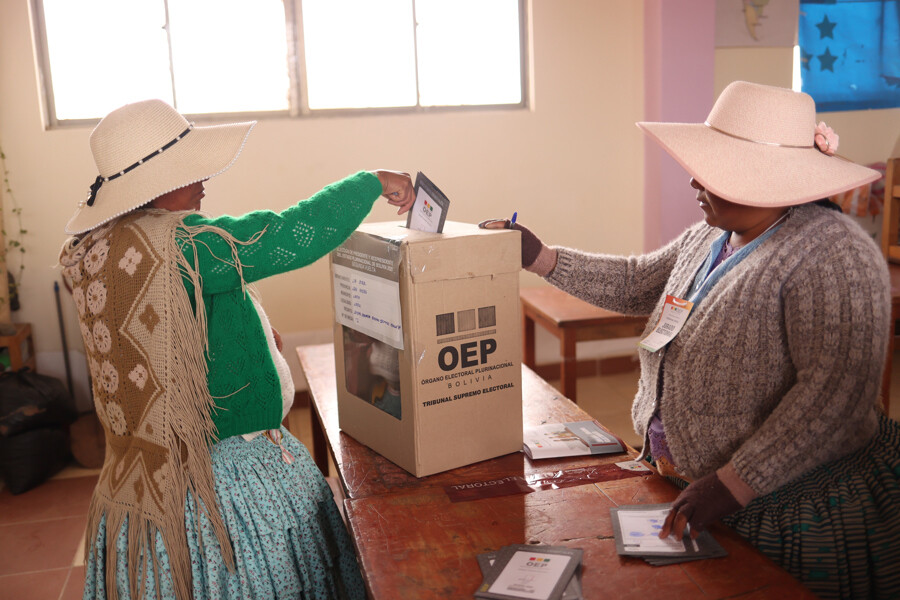
Bolivians will head to the polls again on Sunday, nearly five months after the general elections, to choose regional and municipal authorities in a different political scenario, marked by the end of nearly two decades of hegemony by the Movement for Socialism (MAS) and a power struggle over the distribution of public resources and regional autonomy. Here are the keys to how Bolivia faces these elections: The reduced MAS and other parties present. Although the Movement for Socialism (MAS), which governed Bolivia for almost 20 years, was reduced to minimal parliamentary representation after winning only 3.16% of the vote in the 2025 general elections, it did not lose its legal status and will participate in the regional elections, albeit with a reduced number of candidates for local positions in various regions. Alongside MAS, other organizations are also competing, such as the Third System Movement (MTS), APB-Súmate, Revolutionary Left Front (FRI), as well as National Unity (UN) from Doria Medina, and the Libre alliance of former President Jorge 'Tuto' Quiroga (2001-2002). According to the TSE, more than 14 parties and 29 alliances are competing in the elections. Over 5,000 positions at stake. In total, Bolivians will elect 5,432 regional and municipal authorities on March 22 for the next five years. The main positions include the governors of the country's nine departments and the mayors of 335 municipalities, as well as regional assembly members and councilors. 'Evistas' and 'masistas' in other alliances. For these regional elections, MAS candidates are running, including former followers of former Presidents Evo Morales (2006-2019) and Luis Arce (2020-2025), to be governors, mayors, or assembly members in different regions, but they are represented by various political alliances. Among them are Leonardo Loza, a former MAS senator and close ally of Morales, who is now a candidate for governor of Cochabamba (central region) and was registered with the Unidos por el Pueblo alliance; and César Dockweiler, a former MAS member who was also close to the former governor, now running for mayor of La Paz with the Ciudad Humana group, which he himself founded. However, the new Unidos por los Pueblos alliance brings together most of the candidates representing MAS, including followers of both Morales and Arce, all backed by the Sole Confederation of Peasant Workers of Bolivia (Csutcb). The ruling party divided into different blocs. The Christian Democratic Party (PDC), which brought the duo of Rodrigo Paz and Edmundo Lara to the presidency, is going to the regional elections divided into at least three groups, according to the Supreme Electoral Tribunal (TSE). Likewise, both the president and vice president, who remain at odds, have opted to promote separate alliances for the electoral dispute in the governorships and mayoralties. Paz formed the 'Patria' alliance with the participation of his political ally Samuel Doria Medina; former La Paz mayor Luis Revilla; and the inclusion of the historical Revolutionary Left Movement (MIR), which was once led by his father, former President Jaime Paz Zamora (1989-1993). Lara, on the other hand, failed to get the TSE to recognize his political group Nuevas Ideas con Libertad due to lack of legal status, so his candidates registered with other alliances. The '50/50' plan and resource distribution. President Rodrigo Paz's '50/50' electoral proposal advocates for a new redistribution of the state's economic resources so that governorships and mayoralties have 50% of total fiscal revenue, as a way to strengthen their autonomy. The initiative has generated controversy over the deadlines and legal steps necessary for its implementation. According to Paz, implementing the '50/50' plan requires repealing 60 laws and 40 decrees.