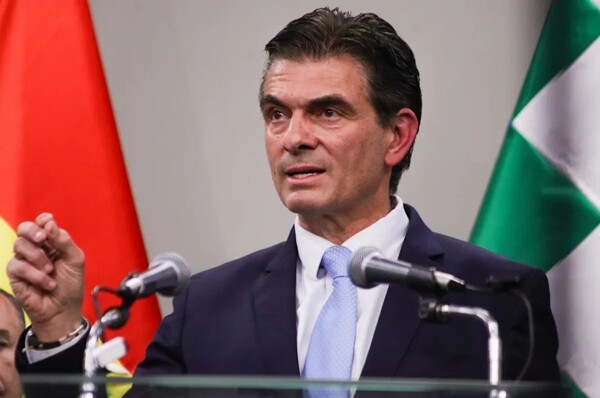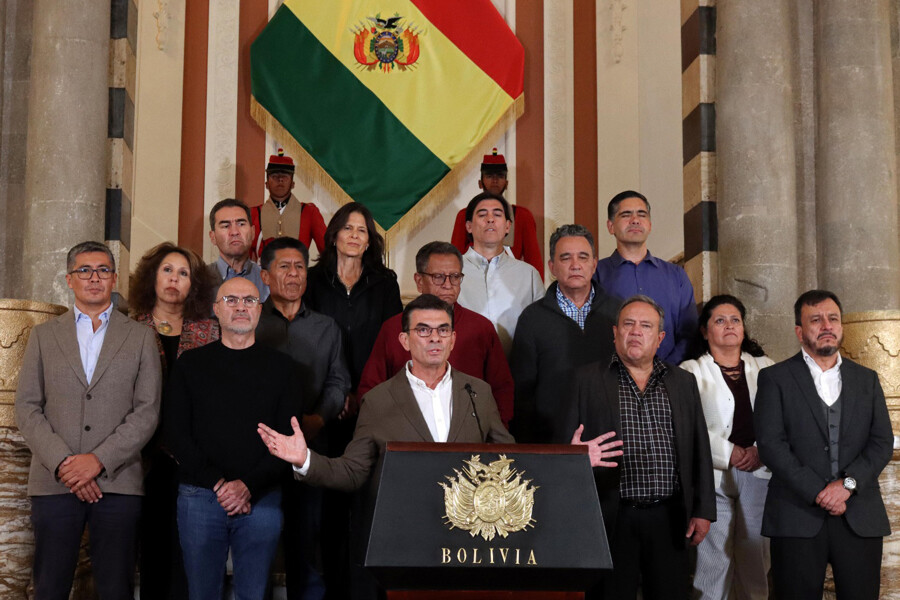
President of Bolivia, Rodrigo Paz, stated this Sunday that decree 5503, which withdrew fuel subsidies, 'fulfilled its function' and will remain as an 'economic conquest,' while announcing a 'new decree' with which his ministers committed to the unions that rejected the norm.
In a televised message, Paz highlighted the dialogue developed by his ministers in the last ten days with different sectors, including the Bolivian Workers' Central (COB), which had been holding street protests since December and road blockades since last Tuesday to demand the repeal of decree 5503.
'With that dialogue, decree 5503 fulfilled its function, an economic conquest, a social conquest, but we need to take a new step, we need a new decree,' the ruler stated.
The announcement comes after the ministers agreed with the COB to repeal decree 5503, issued on December 17, and to draft a new norm that maintains the withdrawal of fuel subsidies but repeals other provisions that generated rejection in those sectors.
The president stated that 'Bolivia needs order, control, and stability, but above all to grow,' so now 'the stage that will lead to a new decree to consolidate' the 'economic and social conquests' established in his little more than two months in office will begin.
Paz confirmed that the withdrawal of the subsidy allowed a daily saving of 10 million dollars 'that mean works and jobs,' but that for each day of road blockades, '20 million dollars in works, jobs, and production' were lost.
'The subsidy was eliminated and that is an economic conquest and that will not change,' he insisted.
He also stated that the 'future' being built 'is at risk when some prefer chaos over a country that works' and pointed out that the blockades 'prevent Bolivia from healing' from the crisis it has been dragging for years.
In addition, he highlighted that in the country there are 'very good' union leaders who are 'honest and transparent,' but there are others 'who lie and hide behind the blockade' and 'promote conflict while protecting their privileges.'
For this, he announced that in the coming months he will personally dialogue 'with the bases' of unions and social organizations 'so that there are no those bad leaders who lie to them.'
The COB and peasant unions, which were political allies of the Governments of Evo Morales (2006-2019) and Luis Arce (2020-2025), carried out street protests that escalated to road blockades since last Tuesday against decree 5503.
That norm established prices of 6.96 Bolivians (one dollar) per liter of special gasoline, 11 Bolivians (1.58 dollars) for premium gasoline, and 9.80 Bolivians (1.40 dollars) for diesel, among others, which implies increases of 86% and 162% compared to the subsidized costs that were in effect for more than 20 years.
The unions also questioned the decree because they consider it opens the possibility of the sale of Bolivia's natural resources and state companies to foreign capital, something that the Government has denied.
The norm provided for other complementary measures, such as the increase in the minimum wage, from 2,750 to 3,300 Bolivians (395 to 474 dollars), and increases in a school bonus and a pension for the elderly without social security contributions, which, as agreed between the Government and the COB, will be maintained in the new decree.
After the agreement signed this Sunday afternoon, the COB ordered the cessation of all pressure measures.