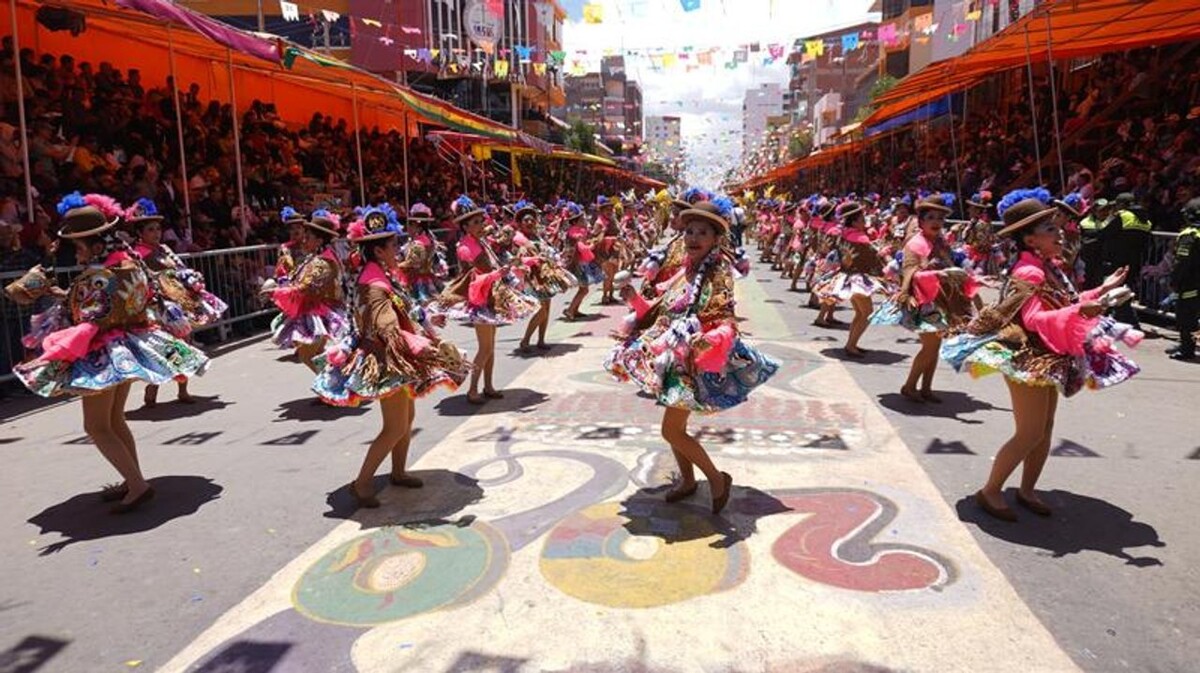
The Carnaval celebrations in Bolivia extend throughout the country, from north to south and from west to east, with each region contributing its own cultural interpretation to these festivities full of pride and joy.
In southern Bolivia, the festivities begin with the traditional Jueves de Comadres in Tarija, a day where women reinforce friendships by exchanging baskets adorned with fruits, streamers, flags, bread, wine, and sweets to the rhythm of traditional music. Bolivia experiences its Carnaval as a vibrant display of culture, devotion, and tradition, where music, dance, and ancestral rituals intertwine in one of the region's most emblematic festivities.
From the majestic entrance of the Carnaval de Oruro in the west, through the playful pepinos and the ch'utas dance in La Paz; the lively comadres in Tarija, the exuberant comparsas in Santa Cruz, to the colorful Corso de Corso in Cochabamba in the center, the entire country becomes a stage where culture, folklore, and national identity are celebrated with pride.
Marianela Tarifa, an expert in intangible heritage, highlighted the relevance of these regional events as an authentic showcase of the rich Bolivian traditions, stating that Carnaval is a symbol of female empowerment and community strengthening. In La Paz, the Jisk'a Anata, an indigenous expression of Carnaval, revives indigenous dances and clothing every Monday during these festive days in Bolivia.
Ana Patricia Huanca, a heritage expert and educator, explained that the Bolivian Carnaval is not just joy and color, but also a gratitude to Pachamama. The Martes de Ch'alla, a ritual offering for prosperity and received goods, is celebrated with fruits, alcohol, wine, flowers, and streamers.
The Carnaval de Oruro, recognized by UNESCO as a Masterpiece of the Oral and Intangible Heritage of Humanity, is the central event of the festivities in Bolivia, reflecting the deep connection of Bolivians with their indigenous heritage. The official closing in Cochabamba with the Corso de Corsos will take place on March 9, a large-scale parade with more than 70 fraternities.
In La Paz, the burial of the Pepino will take place, while in Santa Cruz, there will be a display of comparsas in the style of Brazilian sambas. The "Carnaval de Calle" in Santa Cruz is experienced with strength, where emblematic dances and band music bring this ancestral celebration to life. More than 80,000 dancers and musicians fill the streets in a manifestation of devotion to the Virgin of Candelaria.
The folkloric parade, which lasts more than 18 uninterrupted hours, is an act of resistance and fervor for participants and spectators, symbolizing the struggle between good and evil with the protection of the Virgin of Socavón.