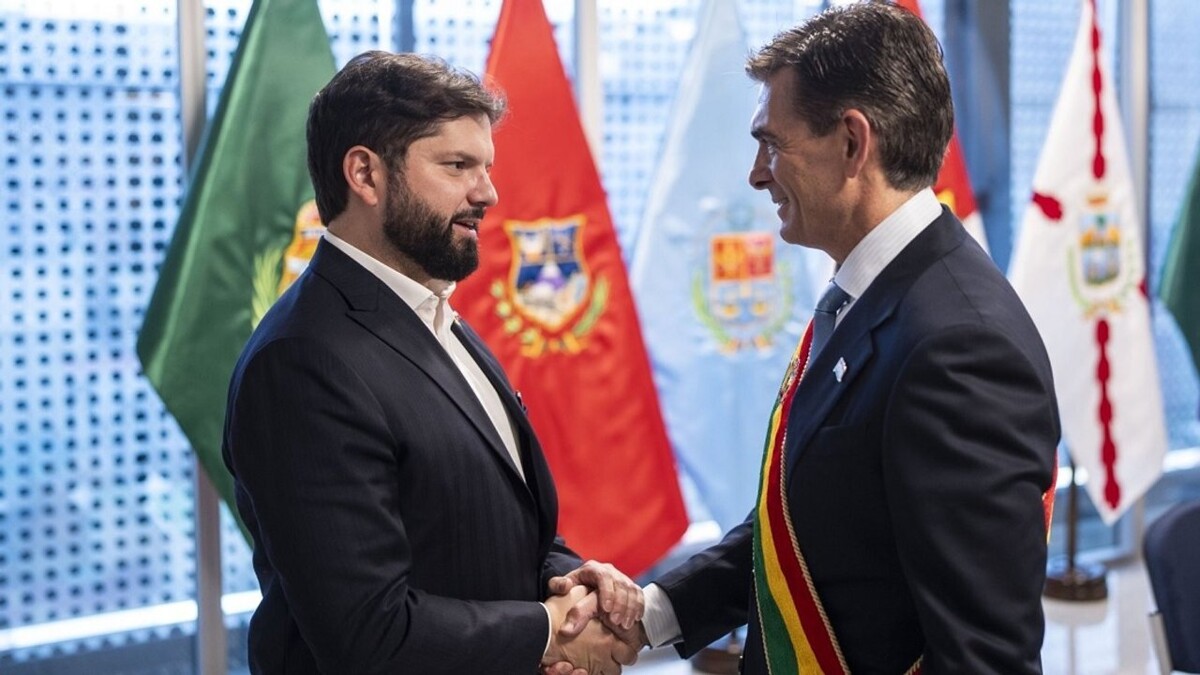
Chilean President Gabriel Boric met on Saturday in La Paz with the new Bolivian leader Rodrigo Paz in the first summit between heads of state of both countries in 19 years. The meeting took place during Paz's inauguration, which, according to the Chilean government, 'marks a turning point in a historical relationship' marked by the diplomatic break of 1978 and prolonged tensions, especially after Bolivia's maritime claim presented to the International Court of Justice (ICJ). The Chilean government emphasized that it had been 19 years since a Chilean head of state attended a inauguration in Bolivia, with the last being in 2006 by Ricardo Lagos. The bilateral relationship had reached one of its most tense moments in 2013, when Bolivia turned to the ICJ to request sovereign access to the Pacific Ocean, a claim that was rejected in 2018. During a recent interview, Rodrigo Paz stated that 'relations with Chile have to change'. The new Bolivian president added that the relationship with Chile is strategic and fundamental for Bolivia's participation in the Asia-Pacific Economic Cooperation (APEC) forum. The Chilean government highlighted that cooperation has strengthened in recent years with the signing of several agreements in 2023 and 2024 'aimed at combating transnational organized crime'. According to a press release from the Government of Chile, Boric held 'a protocolary greeting with President Paz to congratulate him and wish him success in his mandate, in addition to delving into the importance of strengthening ties and joint work in matters such as border control and the Chile-Bolivia Binational Business Council'. Paz, a centrist leader of the Christian Democratic Party (PDC), took office after an unprecedented second-round election on October 19, ending 26 years of rule by the Movement for Socialism (MAS). The new president inherits an economy marked by a shortage of foreign currency and fuels. In his speech after taking office, Paz announced that he will promote a 'capitalism for all', based on economic formalization, tax reduction, and stimulating investment. He reaffirmed his intention to more than halve fuel subsidies and modernize the country's energy and digital systems. 'We will defend our rivers, our forests, and our glaciers. Economic development will go hand in hand with respect for the environment,' he assured during his speech, in which he also proposed launching a 'green government.' Paz swore the office with the promise that 'never again' would Bolivia remain 'isolated' from the world. 'Never again an isolated Bolivia, subject to failed ideologies, much less a Bolivia with its back to the world,' expressed Paz before more than seventy international delegations at the inauguration ceremony, held at the Legislative Palace of La Paz. Also attending were other presidents such as Javier Milei (Argentina), Daniel Noboa (Ecuador), Santiago Peña (Paraguay), Yamandú Orsi (Uruguay), as well as the US Under Secretary of State Christopher Landau and representatives from Spain and the European Union.